Best Amazon PPC Tools 2026
Expert reviews of Amazon PPC management software — automated bid management, campaign optimisation and ACOS improvement for Amazon sellers.
6 PPC tools reviewed and verified — July 2026.
What Is Amazon PPC Management Software?
Amazon PPC (Pay-Per-Click) advertising lets sellers pay to appear at the top of search results and product pages. Sponsored Products, Sponsored Brands and Sponsored Display campaigns each serve different purposes — from driving keyword-based discovery to retargeting shoppers who have viewed your products. Managed manually, Amazon PPC requires constant bid adjustments, keyword research, negative keyword management and campaign restructuring to stay profitable. PPC management software automates the most time-consuming parts of this process.
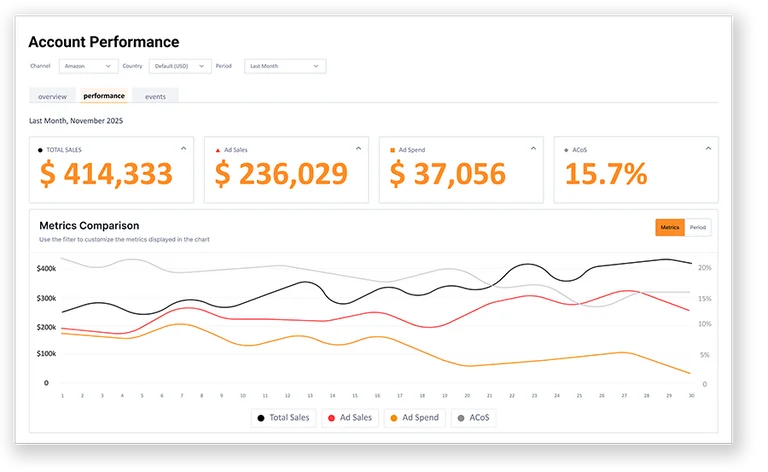
The key metric in Amazon advertising is ACoS — Advertising Cost of Sales, your ad spend as a percentage of attributed revenue. A well-managed PPC account keeps ACoS at or below your target threshold while maximising the volume of profitable sales. PPC management tools help achieve this by automating bid adjustments based on performance data, identifying new keyword opportunities, suppressing wasteful spend on irrelevant search terms, and providing the reporting clarity needed to make good decisions.
Automated Bid Management
Manual bid management requires checking performance data regularly and making bid adjustments based on conversion rates, ACoS targets and keyword competitiveness. PPC tools automate this — using algorithms or machine learning to adjust bids at the keyword level based on your target ACoS and historical performance data. The best tools update bids more frequently and more precisely than any manual process can.
Keyword Research and Harvesting
Finding profitable keywords and moving them from automatic campaigns (where Amazon decides which search terms to show you for) to manual campaigns (where you set explicit bids) is called keyword harvesting. PPC tools automate this process — identifying search terms that are generating sales in automatic campaigns and creating manual targeting for them at appropriate bids.
Negative Keyword Management
Irrelevant search terms that trigger your ads but do not convert waste budget and inflate ACoS. Adding negative keywords — search terms you explicitly exclude — is one of the highest-impact optimisations in Amazon PPC. PPC management tools identify search terms that are generating clicks but no sales and recommend or automatically add them as negatives.
How We Choose the Best Amazon PPC Tools
Every tool we review has been tested or demo-verified. No sponsored placements, no affiliate influence on rankings.
Bid Algorithm Quality
We assess how the tool's automated bidding logic works — whether it uses rule-based or machine learning approaches, how frequently it updates bids, and whether its ACoS targeting is precise or approximate.
Campaign Structure Tools
We evaluate whether the tool helps you build well-structured campaigns from scratch, automate keyword harvesting from auto to manual, and manage negative keywords systematically.
Reporting Depth
We assess the quality of PPC analytics — whether you can see true profit after ad spend (not just ACoS), track performance by campaign, ad group and keyword, and export data for external analysis.
Value vs Ad Spend
We compare tool cost against the ad spend tiers it serves — a $79/month tool that covers $3,000/month in ad spend has a very different value proposition to one that charges a percentage of spend.
How Amazon PPC Actually Works
When you run a Sponsored Products campaign, Amazon enters your listing into an auction every time a shopper performs a search. Your bid — combined with your ad quality score, listing relevance and conversion rate history — determines whether your ad appears and in what position. You pay only when a shopper clicks your ad, not when it is shown.
Amazon PPC campaigns run in three match types: exact (your ad appears only for the precise keyword you bid on), phrase (your ad appears for searches containing your keyword phrase), and broad (your ad appears for loosely related searches). Each match type serves a different purpose. Exact targets proven converting terms at controlled bids. Broad discovers new search terms you might not have identified. Phrase balances discovery with some control over relevance.
Automatic vs Manual Campaigns
Automatic campaigns let Amazon decide which search terms to show your ad for, based on your listing content. Manual campaigns require you to specify the keywords you want to bid on and set individual bids per target. Most experienced sellers run both — automatic campaigns to discover new converting search terms, manual campaigns to scale what works with precise bids.
What Is ACoS and Why Does It Matter?
ACoS stands for Advertising Cost of Sales — your ad spend divided by attributed ad revenue. If you spend £100 on ads and generate £400 in attributed sales, your ACoS is 25%. Your target ACoS depends on your product margin. If your gross margin before advertising is 35%, an ACoS below 35% means advertising is profitable. TACoS — Total ACoS — divides your ad spend by total revenue including organic sales, giving a truer picture of advertising's overall business impact.
Why Manual PPC Management Breaks Down at Scale
A seller with 50 ASINs running across Sponsored Products, Sponsored Brands and Sponsored Display might have thousands of active keywords across hundreds of ad groups. Reviewing bid performance, harvesting converting search terms, adding negatives and adjusting bids across all of this manually — even weekly — is impractical. PPC management software automates the monitoring and execution layer, freeing you to focus on strategy rather than bid spreadsheets.
How to Choose an Amazon PPC Tool
1. Rule-Based vs Machine Learning Bidding
Rule-based PPC tools execute bid adjustments according to logic you define — if a keyword's ACoS exceeds X%, reduce the bid by Y%. This gives full transparency but requires you to define the rules correctly. Machine learning tools build models per keyword and automatically adjust bids to hit your target ACoS. ML bidding can outperform rules at scale but is less predictable and harder to audit.
2. Pricing Model — Flat Fee vs Percentage of Ad Spend
Some PPC tools charge a flat monthly fee tiered by ad spend. Others charge a percentage of total ad spend — typically 2-3%. For low-spend accounts, percentage pricing can be cheaper. For high-spend accounts, flat fee tools become significantly more cost-effective. At £30,000/month in ad spend, a 3% fee costs £900/month. A flat fee tool at the same spend level might cost £200-400/month.
3. Campaign Creation vs Optimisation Only
Some tools only optimise existing campaigns — adjusting bids and managing negatives on campaigns you have already set up. Others can create well-structured campaigns from scratch. If you are starting from a poor campaign structure, a tool that can rebuild your account is more valuable than one that only optimises what already exists.
4. Reporting — ACoS Only vs True Profit
ACoS tells you the efficiency of your ad spend relative to attributed revenue — it does not tell you whether you are making a profit after all costs. Tools that integrate with your cost data to show true profit after ad spend give a more actionable view than ACoS alone. If a tool only shows ACoS without profit context, you are making optimisation decisions based on incomplete information.
5. Marketplace Coverage
Most Amazon PPC tools support Amazon US and major European marketplaces. Coverage of Amazon Japan, Australia, UAE and other regions varies. If you run advertising across multiple Amazon marketplaces, confirm the tool supports all your active regions before committing.
Amazon PPC Tools FAQ
Do I need a PPC management tool or can I manage ads manually?
With fewer than 5-10 ASINs and modest ad spend, manual management is viable if you check performance weekly. Above that threshold, the volume of keywords, match types, search term data and negative keyword opportunities grows faster than manual management can handle. Most sellers running more than £5,000-10,000 per month in ad spend find PPC tools pay for themselves through reduced wasted spend and better bid precision.
What is a good ACoS target for Amazon PPC?
Your target ACoS should be below your gross margin percentage to ensure advertising is profitable. If your gross margin is 40%, an ACoS below 40% means you are making money on ad-attributed sales. Many sellers target 25-30% ACoS, but the right number is specific to your product economics — not a universal benchmark.
Is Amazon PPC software different from a repricer?
Yes — they solve different problems. A repricer adjusts your product listing price to win the Buy Box. A PPC tool manages your advertising campaigns — bid levels, keyword targeting and campaign structure. Both aim to increase sales but operate in entirely different parts of the Amazon ecosystem. They are complementary rather than competing tools.
What is the difference between Sponsored Products, Sponsored Brands and Sponsored Display?
Sponsored Products are ads for individual listings appearing in search results and on product pages — the most widely used format. Sponsored Brands feature your brand logo and multiple products at the top of search results. Sponsored Display retargets shoppers on and off Amazon who have viewed your products. Most sellers start with Sponsored Products and add other formats once they have catalogue depth.
How much of my revenue should I spend on Amazon advertising?
Most established Amazon sellers spend 5-15% of revenue on advertising, but this varies significantly by category, competition level and margin structure. New product launches typically require higher ad spend to build sales history and organic ranking. The right measure is not spend as a percentage of revenue but net profit after all advertising costs.
Will a PPC tool connect to my existing Amazon campaigns?
Yes — all major PPC management tools connect via the Amazon Advertising API and read your existing campaign structure and historical performance data. You do not need to rebuild campaigns from scratch, though some tools will recommend restructuring poorly organised accounts for better results.