How to Win the Amazon Buy Box
What it is, how Amazon awards it, and what actually moves the needle on your Buy Box percentage.
What Is the Amazon Buy Box?
The Buy Box is the Add to Cart and Buy Now button displayed on an Amazon product listing page. When multiple third-party sellers offer the same product at the same condition, Amazon selects one seller to feature in that button at any given moment. That seller is said to hold the Buy Box.
Sellers not featured in the Buy Box appear in the Other Sellers on Amazon section further down the page — a section most buyers never scroll to. For practical purposes, if you are not in the Buy Box, you are not selling. The effect is amplified on mobile, where the alternative sellers section is even harder to find.
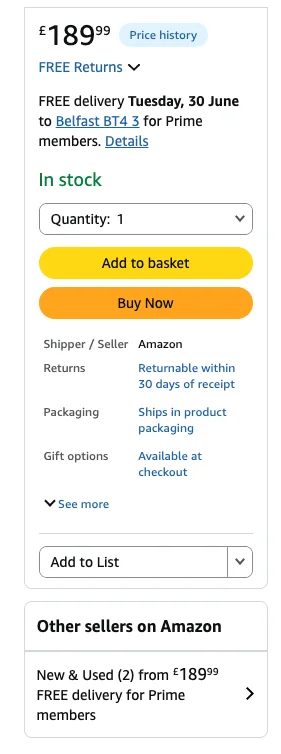
The Amazon Buy Box — the primary Add to Cart button.
Amazon does not award the Buy Box permanently to one seller. It rotates between eligible sellers based on a proprietary algorithm that takes into account price, fulfilment quality, seller metrics and stock availability. The proportion of time a seller holds the Buy Box on a given listing is called their Buy Box percentage.
Who Is Eligible for the Buy Box?
Not all Amazon sellers are automatically eligible for the Buy Box. To be eligible, you generally need a Professional selling account, a sustained track record of sales activity, and seller performance metrics within Amazon's required thresholds.
Amazon's seller performance targets include an Order Defect Rate below 1%, a Pre-fulfilment Cancellation Rate below 2.5%, and a Late Shipment Rate below 4%. Accounts consistently breaching these thresholds risk losing Buy Box eligibility entirely.
FBA sellers have a structural advantage because Amazon controls the fulfilment quality for those orders directly. FBM sellers must meet additional shipping performance requirements and are generally assessed more stringently on delivery speed and reliability.
What Factors Determine Who Wins the Buy Box?
Amazon has not published the exact weighting of its algorithm. However, five factors have the most consistent impact.
Price (Including Shipping)
Landed price — item price plus shipping — is the most frequently cited factor and the most directly controllable one. This does not mean the cheapest price always wins. Amazon weights price relative to other quality signals. A slightly higher price from a seller with stronger metrics may still win the Buy Box over a cheaper seller with weaker performance.
Fulfilment Method
FBA gives a significant structural advantage. Amazon views its own fulfilment network as a quality guarantee. FBM sellers can compete but face higher scrutiny on delivery performance. Seller Fulfilled Prime is available to high-performing FBM sellers but the eligibility bar is high.
Seller Performance Metrics
Order Defect Rate, Late Shipment Rate and Pre-fulfilment Cancellation Rate are the three metrics most directly tied to Buy Box eligibility. Response time to customer messages, feedback rating and feedback volume all contribute to algorithmic standing.
Stock Availability
Amazon will not award the Buy Box to a listing it cannot fulfil. For FBA sellers, maintaining adequate stock at Amazon fulfilment centres is a Buy Box issue as well as a sales issue. When FBA stock runs low, Amazon may stop serving the Buy Box before actual stockout.
Shipping Speed
For FBM sellers, the promised delivery date matters. Sellers offering faster delivery windows — particularly those enrolled in Seller Fulfilled Prime — are treated more favourably than those with longer estimated delivery times.
How to Improve Your Buy Box Percentage
1. Use FBA Where It Makes Sense
If you are not already using FBA, it is the single highest-impact change for Buy Box performance. FBA removes fulfilment-related metric risk, makes your listings Prime-eligible, and gives you the structural algorithm advantage that comes with Amazon controlling the delivery. The FBA fee cost needs to be modelled against the expected increase in Buy Box share to assess whether it makes economic sense per product.
2. Price Competitively — Not Just Cheaply
Price is the most controllable Buy Box lever. But the goal is not to be the cheapest — it is to be the most competitive at the highest viable price. A repricing tool automates this balance, monitoring competitor prices in real time and adjusting your price to stay competitive without racing to the bottom.
3. Maintain Clean Seller Metrics
Monitor your Account Health in Seller Central regularly. Your Order Defect Rate, Late Shipment Rate and Cancellation Rate directly affect both your eligibility and your competitiveness. If any metric approaches Amazon's threshold, investigate and fix the root cause immediately — the Buy Box impact arrives before any formal warning.
4. Keep Stock Levels Healthy
Stock-outs are a Buy Box killer. When your FBA stock runs low, Amazon may stop serving your listing in the Buy Box before it actually reaches zero. Build reorder triggers that account for lead times, shipping delays and Amazon's intake processing time, not just raw unit counts.
5. Respond to Customer Messages Promptly
Amazon measures your response time to customer messages. A response time consistently under 24 hours is the standard. Slow responses affect your seller feedback rate indirectly and contribute to a pattern of metrics that reduces your algorithmic standing over time.
Common Buy Box Misconceptions
The cheapest price always wins. Not true. Price is one factor alongside fulfilment method, seller metrics and stock availability. A higher-priced FBA seller often beats a lower-priced FBM seller.
You need thousands of reviews to be competitive. Seller feedback (your account-level star rating, not product reviews) is a factor, but a solid rating from a modest number of responses is sufficient for most categories.
Amazon always takes the Buy Box for itself. Amazon retail does compete in the Buy Box when it sells the same product, but it stock-outs frequently and is absent from many listings — creating genuine opportunity for third-party sellers.
Buy Box FAQ
Does Amazon itself compete for the Buy Box?
Yes. When Amazon retail sells the same product, it competes using the same algorithm signals and typically wins when it has stock. However, Amazon retail stock-outs frequently, creating Buy Box windows for third-party sellers.
Can I see my Buy Box percentage?
Yes. In Seller Central, go to Reports > Business Reports > By ASIN > Detail Page Sales and Traffic by Child Item. The Buy Box Percentage column shows your share of page impressions during which you held the Buy Box.
Does having more reviews help win the Buy Box?
Seller feedback rating (your account-level star rating, not product reviews) is a factor. A higher rating from a meaningful number of responses contributes positively. Product reviews are separate from seller feedback and are not a direct Buy Box factor.
What happens to my Buy Box share when I raise my price?
It depends on the competitive landscape. If you are the only eligible seller or competitors are out of stock, you can raise price significantly without losing the Buy Box. If there are active competitors at lower prices, raising your price will reduce your share — exactly the trade-off a repricing tool manages automatically.
Is the Buy Box the same across all Amazon marketplaces?
The Buy Box exists on all Amazon marketplaces globally, but eligibility requirements and algorithm weightings vary by marketplace. Performance thresholds, FBA infrastructure quality and competitive dynamics differ between Amazon US, UK, Germany, Japan and other regions.