MAP Pricing on Amazon: A Complete Guide
What Minimum Advertised Price is, how it works on Amazon, and how brands and sellers should think about it.
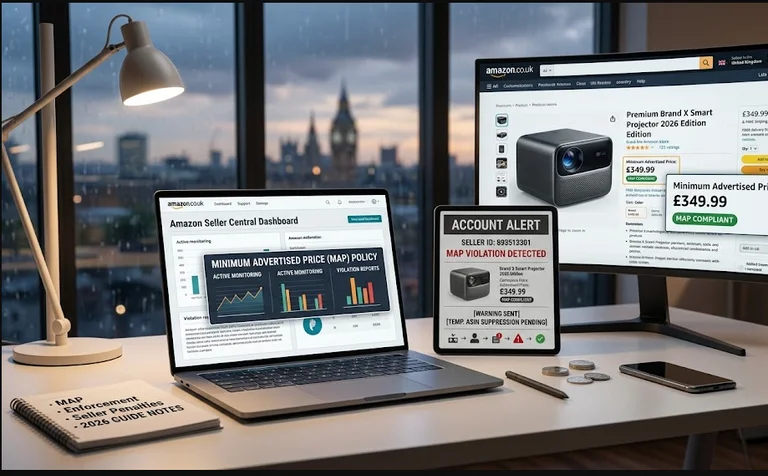
MAP monitoring tracks reseller pricing across all channels — identifying violations before they undermine your distribution strategy.
What Is MAP Pricing?
MAP stands for Minimum Advertised Price. It is the lowest price at which a retailer or reseller is permitted to advertise a product, as set by the brand or manufacturer. MAP policies are established by brands as a condition of their distribution agreements — retailers who wish to stock and sell the brand's products must agree not to advertise below the defined floor.
MAP is an advertised price floor, not a sales price floor. In many jurisdictions, brands cannot legally dictate the price at which a retailer sells a product — that would constitute resale price maintenance, which is restricted under competition law. What brands can do is restrict how the product is advertised — including on product listing pages, in emails, in paid ads and on price comparison sites.
On Amazon, a product's listing page price is generally treated as its advertised price for MAP purposes. A seller who lists below MAP is typically considered to be in violation of the policy, even if they claim the actual transaction price is different.
Why Do Brands Set MAP Policies?
Protecting Brand Positioning
Premium brands invest significantly in positioning their products at a price point that signals quality, exclusivity or value. When a reseller discounts below MAP, that positioning is undermined — potential customers who see the product at a deeply discounted price revise their perception of the brand downward. MAP preserves the price anchor that brand investment has built.
Protecting the Distribution Channel
Authorised resellers invest in stock, staff training, customer service infrastructure and physical or digital merchandising. When unauthorised sellers undercut MAP, authorised resellers cannot compete profitably and lose the motivation to invest in the brand's success. MAP protects the economics of the authorised channel so resellers have reason to invest in sales support and stock.
Preventing Unauthorised Channel Conflict
Brands with brick-and-mortar retail relationships particularly rely on MAP to prevent online sellers from undercutting the in-store price. If a product is available online for significantly less than its in-store price, physical retailers will stop stocking it — removing the brand from premium shelf space the brand has invested in.
How MAP Works on Amazon
Amazon does not enforce MAP policies. Amazon's position is that pricing decisions are between sellers and their suppliers — Amazon will not remove a listing, suppress a Buy Box or penalise a seller on behalf of a brand's MAP policy. MAP enforcement on Amazon is entirely the brand's responsibility.
This creates a monitoring requirement. Brands selling through authorised resellers on Amazon must actively track all sellers on their product listings to identify MAP violations. With hundreds of ASINs and dozens of resellers, manual monitoring is impractical — dedicated MAP monitoring tools are the standard approach for brands with meaningful distribution.
MAP Enforcement Challenges on Amazon
Identifying Who Is Selling
When a product is sold on Amazon by multiple sellers, identifying which specific seller is violating MAP can be complicated. The Buy Box rotates between sellers, and the seller list below the Buy Box may not be immediately visible. Systematic monitoring that identifies all sellers on each ASIN is required for effective enforcement.
The Buy Box Complication
The Buy Box winner's price is what most buyers see first. If a MAP violator holds the Buy Box, their violation is maximally visible and damaging. If they are buried in the Other Sellers section, the damage is lower but still present. Effective MAP monitoring tracks all sellers on a listing, not just the Buy Box holder.
Rapid Price Changes
Sellers using repricing tools can change prices dozens of times per day. A seller may drop below MAP during off-peak hours and return to compliance before a daily monitoring check catches the violation. This is why hourly or real-time MAP monitoring is more effective than daily checks for enforcement purposes.
MAP Pricing: A Seller's Perspective
For authorised resellers, MAP policies define the competitive floor. They create a level playing field among authorised sellers — you know your competitors cannot undercut below a defined price, which protects your margin on stocked inventory.
MAP violations by unauthorised sellers are a separate challenge. Unauthorised sellers who violate MAP put authorised resellers at a competitive disadvantage and damage the brand perception that makes the product worth stocking. Authorised resellers often support brands in identifying unauthorised MAP violators.
For sellers operating independently — including arbitrage and wholesale sellers without a direct brand relationship — MAP policies create a practical floor below which pricing the product would violate the brand's distribution terms. Sellers who source through authorised distributors are typically bound by MAP as a condition of supply.
How Brands Enforce MAP on Amazon
1. Monitor Continuously
The foundation of MAP enforcement is continuous monitoring of all sellers on your product listings across all relevant marketplaces and channels. This requires a monitoring tool that checks prices at sufficient frequency to catch violations — daily monitoring misses intra-day drops that occur with repricing tools.
2. Issue Warning Notices
When a violation is detected, the first step is typically a formal warning notice to the reseller — documenting the violation, citing the MAP policy agreement, and requesting immediate correction. Most authorised resellers will correct a violation promptly on first notice.
3. Escalate or Terminate Supply
Repeat violators or resellers who do not respond to warnings can be escalated — supply can be suspended or terminated. This is the primary enforcement leverage brands have in the absence of Amazon's support for MAP enforcement.
4. Unauthorised Sellers
Unauthorised sellers have no supply relationship to leverage. Enforcement options include brand registry takedowns where the seller is infringing other intellectual property rights, test purchases to identify the supply chain, and legal action in serious cases. This is a more complex enforcement situation than managing authorised resellers.
MAP Pricing FAQ
Is MAP pricing legal?
MAP policies are legal in most jurisdictions when structured correctly as advertised price restrictions rather than sales price restrictions. However, the legal framework varies by country. In the EU and UK, certain forms of resale price maintenance are prohibited under competition law. Brands with international distribution should take legal advice on how to structure MAP policies in each market.
Does Amazon enforce MAP policies?
No. Amazon does not enforce MAP on behalf of brands. Amazon's marketplace rules allow sellers to set their own prices, and Amazon will not act against a seller solely because they have violated a brand's MAP policy. MAP enforcement on Amazon is entirely the brand's responsibility using its own monitoring and distribution management processes.
What happens if I accidentally price below MAP?
If you are an authorised reseller and you price below MAP — even accidentally — you are typically in violation of your distribution agreement. Most brands will issue a warning first for a first-time violation. Correct the price promptly, acknowledge the error to the brand, and implement checks to prevent recurrence. Automated repricing with a correctly set minimum price can prevent accidental MAP violations.
Can I use a repricer and still comply with MAP?
Yes. Set your repricing floor at or above MAP for any products covered by a MAP policy. The repricer will never push the price below that floor regardless of competitive pressure. This is the standard practice for authorised resellers using repricing tools on MAP-protected products.
What is the difference between MAP and MSRP?
MAP (Minimum Advertised Price) is a floor — the lowest price at which a product can be advertised. MSRP (Manufacturer's Suggested Retail Price) is a ceiling suggestion — the recommended price at which the brand believes the product should sell. A seller can price above MAP and at or below MSRP. Pricing below MAP violates the distribution agreement; pricing above MSRP is generally permissible but may affect competitiveness.